Posted by Dennis »
Add Comment »
Recently a minor debate arose on the Byzans-L listserv as to whether Constantinople was originally named by Constantine ‘New Rome’ (in Greek Νέα Ῥώμη, in Latin Nova Roma). I’ve read this claim uncritically a number of times in a number of sources, some of whom are quite good scholars, but it’s a bit like one of those popular attributions that no one ever bothers to check because Oscar Wilde (or Mark Twain) would have said something like that. We read it enough, we hear it enough, and we trust that the tradition we’ve received is accurate.

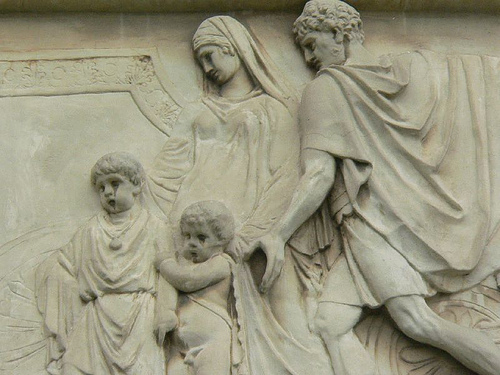
This is not 'New Rome.'
A case was made that the use of New Rome as a name for Constantinople was based on a sort of power struggle among the Churches of the East, and while the reasoning is sound and I accept the argument, I’m more concerned with the notion that New Rome was ever considered a name in the early period.
Adherents to the ‘New Rome’ position point to Canon III of the First Council of Constantinople (AKA the Second Ecumenical Council) of 381 CE:
Constantinopolitanus episcopus habeat priores honoris partes post Romanum episcopum, eo quod sit ipsa nova Roma
(The Bishop of Constantinople may have the better parts of honor after the Bishop of Rome inasmuch [the city] is itself a new Rome.)
This does not say that Constantinople was named ‘New Rome’ but that it was a new Rome, i.e., the seat of the Empire, a claim that no other city could make. If Rome was princeps urbium, then so was Constantinople, and it and its officials should be on similar footing.
It’s the city’s status, not its name that matters. By this logic the city council of New London, CT could officially decree for their mayor an equal share in the honors afforded the mayor of London, England. But would they?
The other source often cited does not say New Rome at all, but ‘a second Rome.’ This is the Ecclesiastical History of Socrates of Constantinople (1.16):
ἴσην τε τῇ βασιλευούσῃ Ῥώμῃ ἀποδείξας͵ καὶ Κωνσταντινούπολιν μετονομάσας͵ χρηματίζειν δευτέραν Ῥώμην νόμῳ ἐκύρωσεν·
(After making it known that it was equal to Rome under his administration and renaming it Constantinople, he decreed by law that it conduct its business as a second Rome.)
The crux here is the word χρηματίζειν, which many want to read in the sense ‘to take and bear a title or name,’ but the problem with this is that, again, it makes no sense to say that having changed the name to X, Constantine decreed that it take the name Y.
Think about that again: after he renamed it Constantinople he decreed by law that it be named Second Rome? Apply some thought.
The usual meaning of χρηματίζειν is to to do business, and specifically the business of the βουλή or the ἐκκλησία. Not only is Constantinople on the same footing as Rome, but it will follow the administration of Rome.
All of this talk of a ‘new Rome’ or a ‘second Rome’ has nothing to do with the city’s name, but with its status and administration.
Posted by Dennis »
2 Comments »
We have certain ideas about Roman fathers, but those ideas are undoubtedly wrong, based on misunderstood bits of legendary history and legal codes.

Photo by Mary Harrsch (via flickr)
We all know about the patria potestas, and the right of life and death over one’s children. We know about the degraded role of women in society. And while Roman society had its flaws, we tend to ignore that Romans were as human as we are and capable of the same affections.
Terence has a few words that speak directly to fathers as we conceive of them. Were they tyrants?
hoc patriumst, potius consuefacere filium
sua sponte recte facere quam alieno metu:
hoc pater ac dominus interest. …
(P. Terentius Afer, Adelphoe, I. 1. 74–6)
“This is fatherly, accustoming a son to do right of his own accord rather than from fear of another: in this respect do a father and a master differ.”
Fathers, in the ideal at least, should be gentle, honest men, somewhat indulgent, and not at all like the popular misconception.
If you want more and better examples and a very nice argument for our misunderstanding of Roman fathers, I recommend Christopher Francese’s Ancient Rome in So Many Words, which you can get for free (at the moment at least) in the Kindle edition. (You don’t need a Kindle—you can get the Kindle App for your PC, Mac, smartphone, or whatever.)
Posted by Dennis »
Add Comment »
Christopher Hitchens, who (I must confess) is a personal hero, recently used an anecdote about the venerable (and notorious) C.M. Bowra (Slate: ‘Anatomy of a Scandal‘), who was a real-life member of the real Order of the Phoenix (unlike that Harry Potter character).
The anecdote is one of those great stories that people like to tell about distinguished types. It’s humorous and humanizing and suits his reputation as a wit. And as one of those stories that people like to tell, Hitchens has told it before (Slate: ‘The Cult of ID‘):
At Oxford, where two rivers meet, there is a private stretch of the bank (or there used to be) called “Parson’s Pleasure.” Since Victorian times, this shaded resort was reserved for male dons who wished to swim and sunbathe in the nude. A barrier prevented any stray punts or boats from interrupting this idyll, and women and girls understood that this retreat was off-limits. One day, however, while the river was higher and faster than usual, a ladies’ boating party was swept through the barrier and into the all-male backwater. Shrieks and giggles from the boat, and a sudden, protective downward reaching of the hands on the part of all bathers on the bank. All but one. The late Sir Maurice Bowra, Hellenist and epigrammist, raised his hands to shield his craggy visage. There they all stood or sat until the fair intruders had sailed past, whereupon a general outbreak of sheepishness occurred, punctuated by Bowra saying: “I don’t know about you chaps, but I’m known by my face around here.”

You needn’t look very hard to find the anecdote here and there, with the quotation changed, or even the subject. It’s been told of others, for example Dundas, whom ‘Mercurius Oxoniensis‘ provocatively referred to as ‘the late Master Robin Dundas, of Christ-Church and Parson’s Pleasure.’
(Try googling +”Parsons’ Pleasure” +”my face”. Then try the same search on Google Books, though not all references include the supposed words of the don.)
In Leslie Mitchell’s biography, Maurice Bowra: A Life, we find a very good explanation, that includes this:
Wadham men found it ‘pleasant to hear all the Jowett stories being told about you.’
The Parsons’ Pleasure story is briefly mentioned as one of the many apocryphal tales ascribed to Bowra as ‘oral myths intended to describe what a great academic might have done.’
It’s still a nice story, but let’s be skeptical.
Posted by Dennis »
2 Comments »
I saw this on the way to work today:

That’s the Volkswagen Phaeton, and maybe I’ve been living under a saxum, but I’d never heard of one before.
Normally we’d approve of a classical reference, but, uh … didn’t he die in a fiery wreck or something?